Photo credit: Emma Davis
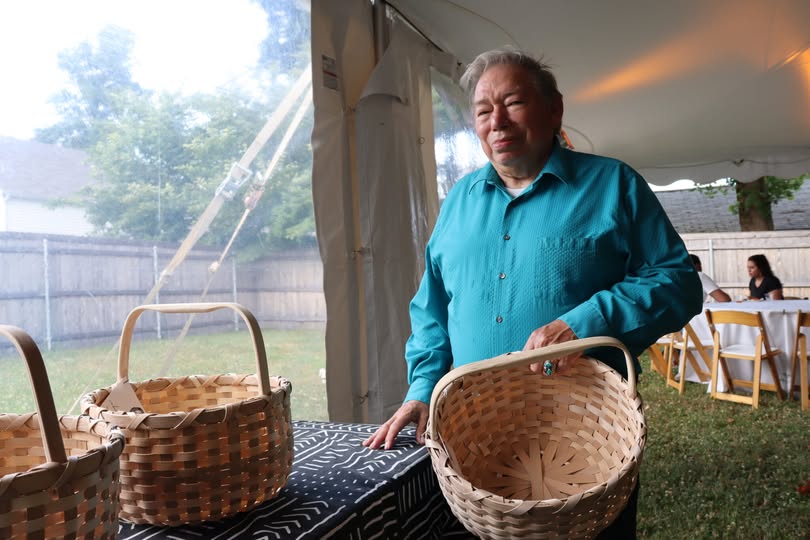
The Honorable Richard Silliboy, a founding member of the Wabanaki Alliance and Vice Chief of the Mi’kmaq Nation for more than 11 years, is one of six individuals honored by the Wabanaki Alliance at the 2026 Nihkaniyane event on October 1 in Freeport.
Silliboy has always been willing to step up and lead to protect and sustain Mi’kmaq and Wabanaki cultural traditions and to improve the economic health and social well-being of all Wabanaki citizens.
While serving as Vice Chief for 11.5 years, Silliboy held leadership roles on as many as 13 different boards and committees — the Abbe Museum, Katahdin Woods and Waters Visitors Center, Wabanaki Community Foundation, Wabanaki Commission on Land and Stewardship, etc. “I didn’t make a lot of baskets during that time,” he told us with a chuckle. He continues to serve on Pine Tree Legal and the Permanent Commission on the Status of Racial, Indigenous, and Tribal Populations, an independent, nonpartisan body with 17 seats that was established in 2019 by Maine law “to advance racial equity and tribal sovereignty by bridging communities and state government.”
A prolific and internationally recognized basketmaker, Silliboy learned the art of traditional Wabanaki basketmaking from his mother as a child growing up in Aroostook County. She had learned to make baskets from her mother, who learned from her mother, and so on, for countless generations. In an interview for the Coastal Maine Botanical Garden, where he has taught basketmaking workshops and demonstrated his art and mastery of storytelling, Silliboy said “the family would make up and sell up to twelve dozen baskets every week” for 50 cents a piece.
But when he was 13, tired of the family routine, Silliboy left home, moved in with his sister, finished school, and worked several jobs. For a time he stopped making baskets.
But about 25 years later in 1985, Silliboy realized that basketmaking was a dying art. He said to himself “I know how to do that.” He returned to basketmaking and that decision has put him on a path to engage in and lead many activities to preserve and protect basketmaking…a spiritual practice “almost like praying,” he has said —that ties him to his cultural history and ancestors, and to future generations.
His path focused on basketmaking has included several roles.
- He served for 10 years as the president of the Maine Indian Basketmakers Alliance.
- In Presque Isle, he managed the Basket Bank, a cooperative of Mi’kmaq basketmakers.
- He has accepted apprentices to learn brown ash basketmaking, at the request of The Maine Arts Commission and Maine Indian Basketmakers Alliance.
- He leads workshops in his Littleton studio and across the state.
Silliboy makes his baskets from brown ash wood —the tree from which the Wabanaki Peoples sprang according to their creation story. The ash tree and, in essence, an important part of Wabanaki culture, are both threatened with extinction. Climate change and the Emerald Ash Borer, an invasive insect that arrived in Michigan in the 1990’s and now infests areas of the Wabanaki homelands, are the culprits. To address the crisis, Silliboy joined a team from the Maine Indian Basketmakers Alliance and University of Maine faculty to do research and take action. For more than 20 years, they have collaboratively been collecting seeds, documenting genetic diversity in basket-quality trees, and using Indigenous knowledge and wisdom. Their work, in which Silliboy continues to be engaged, is now amplified by the Ash Protection Collaborative Across Waponahkik (APCAW) that identifies strategies in harmony with Wabanaki priorities and research. Respected for his knowledge of brown ash and the threats to its survival, Silliboy has attended and presented at several conferences focused on this growing problem.
While continuing his efforts to preserve the resources and art of basketmaking for future generations, in recent years Silliboy has focused his time on strategies to secure land and funding that benefit all Wabanaki Nations. He serves on the Wabanaki Commission on Land and Stewardship that is partnering with First Light, a collective of non-Native land trusts, to return land and money to Wabanaki Nations. He shares with enthusiasm the recent land purchases that expand Mi’kmaq acreage for traditional foraging, hunting, and fishing practices, significantly increase garden space for the successful Mi’kmaq Farms and Fish Hatchery business in Caribou, and contain tree stands suitable to harvest for lumber to build 20 affordable homes Mi’kmaq families can purchase. The trees will be processed at the new Mi’kmaq sawmill in Caribou.
Silliboy’s life in some ways has come full circle. He tells the story about a large laundry basket that his mother made around 1939 for the neighboring farm family. That family had seven children, who all slept in the laundry basket as infants. Silliboy discovered that one of the sons still had the laundry basket in the farmhouse’s attic. Silliboy asked if he might buy it. At the time the son said no. But when the farm was sold, the son visited Silliboy and said, “I want you to have your mother’s basket.” Silliboy turned around and donated the basket to the Southern Aroostook Agriculture Museum in Littleton, where it joins “the world’s largest potato basket” that was created by Silliboy, his daughters and their families and is now on permanent display as part of a gallery showcasing Mi’kmaq history in the area. “That laundry basket was still as good as when my mother made it,” Silliboy said.
Return to the Nihkaniyane: Let’s Go Forward Together post to read more about the other 2026 honorees.